
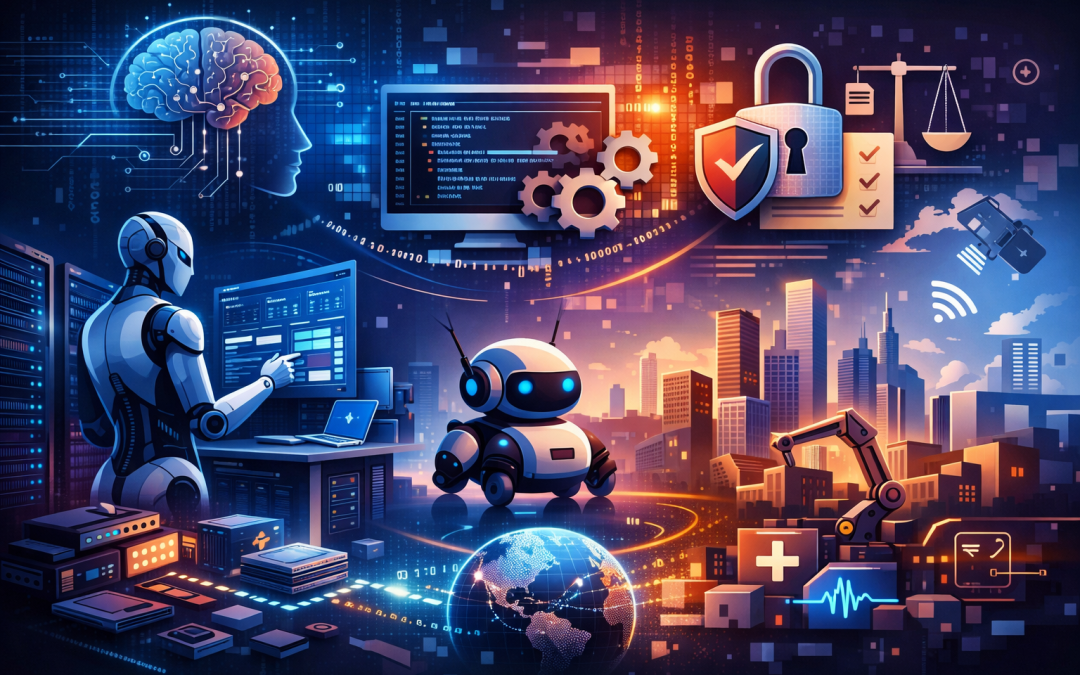
The role of Artificial Intelligence in IT is no longer a distant promise – it is a present reality. In 2026, organizations that understand and act on the most important AI developments will be the ones pulling ahead. Here is a look at five major shifts defining how IT teams operate today, and what they mean for your business.
1. Agentic AI: Letting Systems Do the Work
For years, AI functioned primarily as a recommendation engine, surfacing insights and waiting for humans to act. That dynamic is changing. Agentic AI refers to systems that can carry out multi-step tasks on their own, without waiting for someone to click a button. In IT operations, this looks like automated incident resolution: an AI that detects a problem, consults a runbook, opens a support ticket, adjusts a configuration, and confirms the fix, all without a technician in the loop.
The practical payoff is significant. Response times shrink, on-call burden decreases, and system reliability improves because problems get addressed the moment they surface rather than the moment someone notices them.
2. AI Woven Into Every Stage of IT Delivery
AI is no longer a standalone tool sitting beside your IT processes, it is becoming embedded within them. From the software development lifecycle to monitoring and portfolio management, AI is beginning to understand context in ways that were not possible before. Modern systems can read through code repositories, interpret historical change patterns, and suggest targeted fixes. On the operations side, AI is correlating signals from logs, metrics, and traces to detect problems before they affect end users.
The result is a faster, more proactive IT function, one that spends less time reacting to fires and more time building toward business goals.
3. Doing More With Less: The Efficiency Turn in AI Infrastructure
For a while, the prevailing strategy for improving AI performance was straightforward: add more compute. That approach is giving way to something more sophisticated. Organizations are now building shared internal platforms, sometimes called AI factories, that consolidate data pipelines and standardize how AI capabilities are delivered across teams. At the same time, there is growing interest in models optimized for smaller accelerators and edge environments, which can deliver strong performance without requiring massive infrastructure investments.
This shift makes AI more cost-effective, more scalable, and accessible to a broader range of use cases within the organization.
4. Governance: Building AI You Can Trust
As AI takes on a larger role in IT decision-making, the need for clear oversight structures becomes impossible to ignore. Leading organizations are moving beyond informal policies and establishing formal governance frameworks that define how AI systems are built, monitored, and audited. Transparency is a key priority: stakeholders need to understand not just what an AI system decided, but why it decided it. Equally important is establishing accountability, knowing who owns each AI function and who is responsible when something goes wrong.
Done well, governance does not slow AI down. It creates the confidence that allows organizations to deploy AI more broadly and with fewer reservations.
5. Specialized, Real-Time AI Built for Specific Industries
General-purpose AI tools have delivered real value, but the next wave of impact will come from systems designed for specific industries and use cases. Healthcare, manufacturing, logistics, and other sectors are beginning to deploy AI that understands the nuances of their environments, adapting workflows in real time based on live data streams rather than static models.
This kind of vertical, real-time AI can optimize operations in ways that horizontal tools simply cannot match, delivering measurable business value that is directly tied to how a specific industry actually functions.
What This Means for Your Organization
These five trends — autonomous agents, embedded AI delivery, infrastructure efficiency, responsible governance, and industry-specific solutions — are not independent developments. They are converging into a new standard for how IT operates. Organizations that treat them as integrated priorities rather than isolated initiatives will be better positioned to compete, adapt, and grow.
If your team is working through what any of these shifts means for your environment, our experts are ready to help you think it through. Reach out to schedule a conversation or request an assessment.